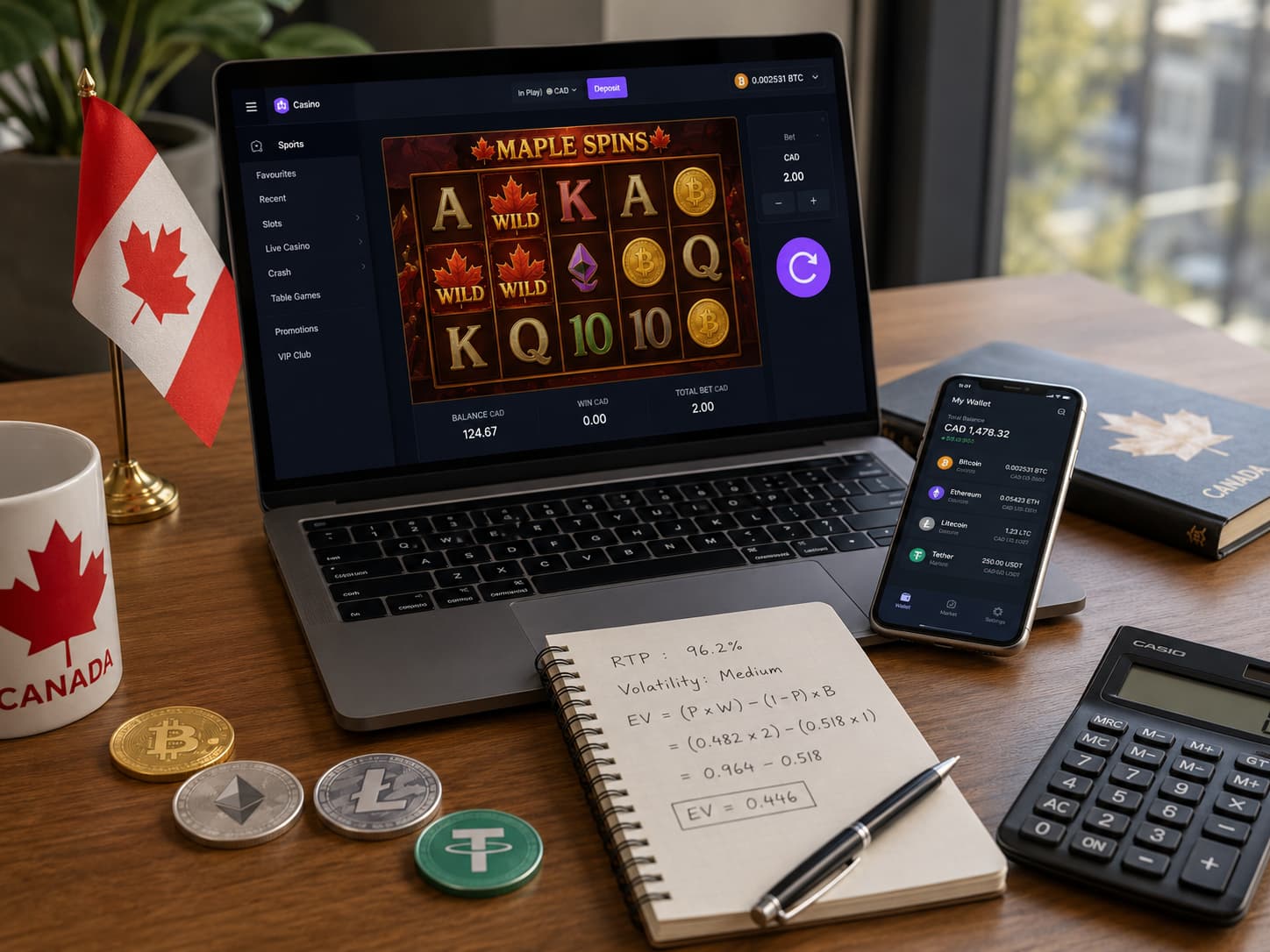
Understanding a blockchain network requires knowing its underlying mathematics — consensus mechanisms, throughput, fee structures, and how those parameters interact under load. Understanding a crypto casino game requires the same approach. The marketing surface of any game is a headline number. The mathematical profile underneath determines what actually happens during sessions.
This guide covers the key metrics that define how crypto casino games behave — RTP, volatility, house edge, hit frequency, and bonus expected value — and explains how those metrics interact in practice for Canadian players in 2026.
RTP: What It Actually Measures
Return to Player (RTP) is the theoretical percentage of total wagers that a game returns to players over an extended period. A slot with 96% RTP returns C$96 for every C$100 wagered, in theory, across a statistically significant sample — typically millions of spins.
The distinction between short-run and long-run behavior is essential. RTP does not predict outcomes in a single session, a single bonus round, or even several hundred spins. It is a long-run expectation calculated over enormous sample sizes. A player who runs a 96% RTP slot for two hours of play has experienced almost no statistically meaningful sample relative to the underlying model.
Why the Same Game Can Have Different RTPs
This is something the blockchain-literate reader will find immediately relevant: a game’s RTP is not fixed globally. Casino operators can configure different RTP versions of the same title from the same game provider.
Pragmatic Play’s Zeus vs Hades, for example, offers configurations at 96.07%, 95.05%, and 94.05%. These are not minor differences. Across a substantial volume of play, the difference between a 96% and a 94% configuration is 2 percentage points of every wager — material over any real session length. The game information panel in-client displays the active configuration at a specific casino; most players never check it.
For Canadian crypto casino players, this has a practical implication: two platforms offering the same slot title from the same provider may be running different mathematical models. Checking the in-game information panel before meaningful play is the same due diligence as checking transaction fees before a network transfer.
RTP by Game Category
Different game categories operate with materially different RTP profiles:
Game Type Typical RTP Range House Edge
Video slots 92%–97% 3%–8%
Classic slots 90%–95% 5%–10%
Blackjack (basic strategy) 99%–99.5% 0.5%–1%
European Roulette 97.3% 2.7%
American Roulette 94.7% 5.3%
Baccarat (banker bet) 98.9% 1.06%
Video poker (optimal play) 98%–99.5% 0.5%–2%
Live dealer blackjack 98.5%–99.3% 0.7%–1.5%
Crash games 97%–99% 1%–3%
The table reveals a clear pattern: skill-adjacent games where optimal strategy can be applied — blackjack, video poker, baccarat banker bet — offer materially lower house edges than pure-chance slots. The trade-off is that applying basic blackjack strategy correctly requires learning the strategy table; it cannot be played optimally by intuition alone.
For crypto casinos specifically, crash games (Aviator, Spaceman, and similar titles) typically display their RTP within the game interface and use provably fair mechanics — the same cryptographic commitment scheme that makes blockchain transaction finality verifiable. The published RTP for Stake’s Aviator, for instance, is 97%, configurable per-operator at some platforms to 95% or lower.
Volatility: The Distribution, Not Just the Average
RTP tells you the average. Volatility tells you the distribution around that average. Both numbers matter. Understanding one without the other gives an incomplete picture of how a game actually plays.
Low volatility games produce frequent small wins. The session bankroll decreases slowly, with regular positive returns. Maximum wins are modest. Long dry spells are rare.
High volatility games produce infrequent but larger wins. Extended periods without significant returns are common. The top payout potential is much higher, but most sessions end without triggering it.
Very high volatility games — a category that includes many modern video slots with large multiplier mechanics — can run for hundreds of spins without a bonus trigger, then produce a single high-multiplier outcome that exceeds all prior losses. The mathematical expectation (RTP) may remain the same, but the path to that expectation varies enormously between sessions.
Volatility in Practice: Olympus vs Hades Logic
Zeus vs Hades implements this distinction as an explicit player choice: Olympus Mode for higher bonus frequency with lower average feature payouts, Hades Mode for lower bonus frequency with higher average feature payouts. The maximum win ceiling is identical in both modes. The distribution of outcomes is different.
This dual-mode design makes explicit what is true but hidden in most slot games: you are choosing a volatility profile every time you select a game, whether or not the game articulates it. A player who prefers session longevity and regular feature triggers gravitates toward Olympus-equivalent low-to-medium volatility games. A player who can sustain longer dry spells in exchange for higher ceiling outcomes gravitates toward Hades-equivalent high volatility titles.
Neither preference is mathematically superior — given the same RTP, the long-run theoretical return is identical regardless of volatility. The difference is experiential and bankroll-management-dependent.
Matching Volatility to Bankroll
A high volatility game with a C$2 minimum bet can deplete a C$100 session bankroll before triggering a single bonus round. The same game with a C$200 bankroll and C$0.50 bets provides statistical room for the variance to play out. Volatility and bankroll must be considered together.
A simple approximation: a session bankroll of at least 100 times the per-spin bet provides reasonable statistical coverage for medium volatility games. High and very-high volatility games with large multiplier mechanics benefit from 200 or more times the bet to survive expected variance between bonus triggers.
Bonus Expected Value: The Math Behind the Offer
The welcome bonus is presented as a headline number. The actual expected value of a bonus is a function of several interacting parameters that must be calculated together, not read separately.
The EV Formula
The simplified expected value of a bonus offer is:
EV = (Bonus Amount × Win Rate) — (Wagering Requirement × (1 — RTP))
Where:
Bonus Amount is the matched or credited amount in CAD
Win Rate is the probability of clearing the wagering requirement before the balance depletes to zero
Wagering Requirement is the total amount you must wager before the bonus converts to withdrawable funds
RTP is the return-to-player of the eligible game type
Why the Terms Matter More Than the Headline
Consider two C$100 bonuses with identical headline values but different terms:
Bonus A: 35x wagering on bonus funds only, slots eligible at 100%, C$2 max bet, 30 days to clear.
Bonus B: 40x wagering on deposit plus bonus (C$200 combined), table games at 5% contribution, C$5 max bet, 7 days to clear.
Bonus A requires C$3,500 in total slot wagers before withdrawal. At a 96% RTP slot, the expected house edge per wager is 4%. The expected cost to the player of clearing the bonus is approximately C$140 (C$3,500 × 4%) against a C$100 bonus value — a theoretical negative EV position before considering the probability of depleting the balance before clearing.
Bonus B requires C$8,000 in effective table game wagers (C$200 × 40x) due to the 5% contribution rate for table games, or C$8,000 of actual table game play to produce C$400 worth of counted wagering. The seven-day expiry for recreational players makes this clearing target operationally impossible. The bonus is structured to expire uncleared in most cases.
These two scenarios have the same C$100 headline but radically different mathematical profiles. The terms document contains the actual product; the marketing contains the marketing.
Game Contribution Rates and Their Effect
Most casino bonus terms specify contribution rates by game type. Common configurations:
Game Type Typical Contribution
Slots 100%
Crash games 100% (varies)
Video poker 10%–20%
Blackjack 5%–10%
Live dealer blackjack 5%–10%
Roulette 5%–10%
Baccarat 0%–10%
Keno 20%–50%
A player who prefers blackjack will find that C$100 in blackjack bets counts as C$5 to C$10 toward the wagering requirement. Clearing a 35x bonus entirely through blackjack at 5% contribution requires C$70,000 in actual table game wagers (C$3,500 required ÷ 5% contribution rate). This is not a calculation error; it is how most bonus terms are structured for skill-adjacent games.
The practical implication: bonuses are overwhelmingly designed for slot play. A player whose primary game type is blackjack, baccarat, or live dealer games is typically better off declining the bonus and playing deposit-only at the higher RTP available in those game categories.
Crash Games and Provably Fair Mechanics

Crash games represent a category that sits at the specific intersection of blockchain mechanics and casino game design. They are worth covering here because their mathematical profile is different from both slots and traditional table games, and their fairness verification mechanism connects directly to the cryptographic concepts this site covers.
How Crash Games Work
A crash game produces a multiplier that grows from 1x upward and crashes at a point determined by a random algorithm. Players bet before launch and must cash out before the crash. If they cash out at 2.5x, they receive 2.5 times their stake. If the game crashes at 1.8x before they cash out, they lose their stake.
The multiplier distribution follows a mathematical curve: most rounds crash below 2x, a meaningful percentage runs beyond 5x, and a small percentage reaches very high multipliers (50x, 100x, or higher). The shape of this distribution is determined by the house edge built into the algorithm.
A 1% house edge crash game has an expected crash point slightly below what a fair game would produce, applied consistently across every round. The RTP equivalent is approximately 99%.
Provably Fair Verification
Most crypto casino crash games use provably fair mechanics: the server generates a seed, hashes it, publishes the hash, the player provides a client seed, and the round result is derived from both. After the round, the server reveals its seed; the player can verify that the published hash matches and that the derived result is correct.
This is the same logic as verifying a blockchain transaction against a published Merkle root: the commitment was made before the outcome, the outcome can be verified by anyone with the revealed data, and retroactive manipulation is detectable. For players who understand hash functions and commitment schemes from the blockchain context, this verification is straightforward to perform.
Several platforms make the verification step accessible through their site interface or through third-party verifiers. Stake’s Fairness page and BC.Game’s provably fair calculator both allow round-by-round verification without requiring a player to run their own code.
Applying This to Canadian Platform Selection
Understanding the mathematics of RTP, volatility, and bonus EV provides a framework for evaluating which Canadian crypto casino platforms are worth using — and which bonus structures are worth claiming.
Best Crypto Casino Canada has evaluated 23 operators across the Canadian market with a methodology that accounts for these factors: real bonus terms including wagering requirements, game contribution rates, maximum bet clauses, and expiry windows rather than headline bonus sizes. The comparison table is sortable by the metrics that matter for informed game selection, and the platform explicitly identifies operators whose bonus structures are structured to never clear — a form of expected value analysis applied to the operator field.
Among the leading Canadian-accessible platforms in 2026:
7Bit Casino (since 2014) runs a 35x wagering requirement on bonus funds only. At a 96% RTP slot, the expected cost to clear is approximately C$140 per C$100 bonus — close to neutral EV for a well-structured offer. The C$2 maximum bet during wagering is the binding constraint. CAD-native interface.
BitStarz runs 40x on deposit plus bonus combined. The higher multiplier applied to the combined amount makes the clearing threshold materially harder than 7Bit. Table games at 5% contribution effectively exclude that game type from bonus clearing. Strongest for pure slot play with the bonus active; best declined by table game players.
wild.io leads on tested payout speed (around six minutes) and offers ongoing rakeback rather than a front-loaded welcome bonus. For players whose primary interest is table games or live dealer — where bonuses offer negative EV — the rakeback model distributes value across all game types proportionally to wager volume rather than restricting it to slots only.
Cloudbet (since 2013) offers 29 coins with CAD denomination. Its welcome package releases through loyalty play, which is a different expected value structure from a standard match bonus: value is earned proportionally over time rather than front-loaded and subject to clearing conditions. For sports bettors who also play casino games, the NHL coverage is the functional differentiator.
JackpotCity holds an AGCO-registered Ontario licence. For Ontario players, the regulated framework includes the requirement that RTP figures advertised for slots be verified by an approved testing laboratory — an additional layer of the mathematical transparency this article has covered.
A practical checklist before claiming any crypto casino bonus in Canada:
Multiply the bonus amount by the wagering requirement to get the total wager needed — not the deposit amount, the bonus amount (or deposit plus bonus if the terms apply to both).
Check which game type you intend to play against the contribution rate table.
Divide the required wager by the contribution rate to get the actual play needed: C$3,500 required ÷ 5% table game contribution = C$70,000 in table game wagers.
Check the maximum bet during wagering and calculate the minimum session time to clear: C$3,500 ÷ C$2 per spin = 1,750 spins minimum.
Check the expiry window against your available session time.
If any of the above numbers makes the clearing requirement impractical, skip the bonus.
Summary
Casino game mathematics is not complicated once the relevant metrics are identified. RTP is the long-run average return. Volatility is the distribution around that average. House edge is the complement of RTP — what the casino retains per wager on expectation. Bonus EV requires calculating the interaction of wagering requirements, contribution rates, maximum bet constraints, and the RTP of eligible games.
None of these calculations require advanced mathematics. They require reading the full terms document rather than the headline, and applying the same analytical discipline that any blockchain network evaluation requires: look at the actual parameters, not the marketing description of them.
For Canadian players building this picture from the ground up, the platform-level comparison work at Best Crypto Casino Canada provides the operator-side data; this guide provides the mathematical framework for interpreting it.
[For more on blockchain network analysis, protocol mechanics, and quantitative approaches to digital asset platforms, explore the network analysis and blockchain trends sections of this site.]
Disclaimer: Gambling carries financial risk and is for adults of legal age — 19+ in most Canadian provinces, 18+ in Alberta, Manitoba, and Quebec. RTP and EV figures in this article are theoretical and based on published game parameters; individual session results will vary. Most crypto casinos accessible to Canadians are offshore operators without provincial consumer protection registration. Ontario’s AGCO-regulated market prohibits cryptocurrency in licensed operations. Nothing here constitutes financial or legal advice. For responsible gambling support: ConnexOntario 1-866-531-2600 or responsiblegambling.org.
About the author: Written by a Canadian crypto and digital finance analyst with a background in quantitative game mechanics, blockchain network analysis, and player-side EV calculation.